
Overview
In July 2026, the Pharmaceutical Benefits Advisory Committee (PBAC) asked us to do a rapid review of medicines listed on the Pharmaceutical Benefits Scheme (PBS) for the treatment of relapsing-remitting multiple sclerosis (RRMS). The review will look into:
- how RRMS treatments are being used on the PBS
- if there is clinical evidence that the PBAC has not considered on how these medicines compare to each other
- if current PBS listings remain contemporary with clinical guidelines and practice.
The PBAC asked for a report by the December 2026 intracycle meeting. We are undertaking this work as a research project under the Post-market Review Framework. We will follow standard PBAC processes and timelines.
Why are we undertaking a rapid review?
There are several medicines listed on the PBS for the treatment of RRMS, which are divided into two tiers based on efficacy, or how well they achieve health outcomes:
- ‘lower-efficacy’ tier
- ‘higher-efficacy’ tier.
The medicines in the higher-efficacy tier were generally listed on the PBS based on cost-minimisation (non-inferior comparative effectiveness and safety) to each other. This means that the medicines were listed on the PBS at a similar cost per patient, because they were considered to have generally equivalent benefits and safety. Over time, some of these medicines have reduced in price on the PBS due to generic competition and Statutory Price Reductions.
The PBS has established pricing policies, such as Reference Pricing Policy, that aligns the subsidy paid for medicines that are considered to provide similar health outcomes. The Department reviewed prices of the higher-efficacy tier RRMS medicines and sought price reductions for certain medicines consistent with this policy.
In July 2026, the PBAC asked us to do a rapid review so that issues resulting from price differences between PBS-listed RRMS medicines can be considered in a structured way, with clinical and patient input. The PBAC wants to address the pricing differences while ensuring access to PBS-subsidised treatments remains patient-centred and clinically appropriate.
Medicines included
All medicines listed on the PBS for the treatment of RRMS will be included in the rapid review (Table 1). Rituximab will also be included, as it is sometimes used in the treatment of RRMS and has an unrestricted benefit listing on the PBS.
Table 1: PBS-listed medicines for the treatment of RRMS, including route of administration and dosing frequency
|
Efficacy tier |
Medicine |
Route |
Abridged dosing frequency |
|
Lower |
Dimethyl fumarate |
Oral |
Twice daily |
|
Lower |
Diroximel fumarate |
Oral |
Twice daily |
|
Lower |
Glatiramer acetate |
SC |
Three times a week |
|
Lower |
Interferon beta 1b |
SC |
Every 2 days |
|
Lower |
Peginterferon beta 1a |
SC |
Every 14 days |
|
Lower |
Teriflunomide |
Oral |
Once daily |
|
Higher |
Alemtuzumab |
IV |
IV on 3 consecutive days, at least 12 months apart |
|
Higher |
Cladribine |
Oral |
Once daily for 4-5 days for two months, for 2 years |
|
Higher |
Fingolimod |
Oral |
Once daily |
|
Higher |
Natalizumab |
IV, SC |
IV/SC over 1 hour, every 4 weeks |
|
Higher |
Ocrelizumab |
IV, SC |
IV/SC every 6 months |
|
Higher |
Ofatumumab |
SC |
Once a month |
|
Higher |
Ozanimod |
Oral |
Once daily |
|
Higher |
Ublituximab |
IV |
IV over 1 hour, every 24 weeks |
|
Higher |
Siponimod1 |
Oral |
Once daily |
|
Higher |
Rituximab2 |
IV |
Two doses (2 weeks apart), every 6 months |
Abbreviations: IV – intravenous; SC – subcutaneous.
Notes:
- The PBS listing for siponimod includes both RRMS and secondary progressive multiple sclerosis (SPMS). Refer to the PBS siponimod listing for the full restriction text.
- In September 2021, the PBAC recommended that the PBS listings for rituximab be changed to Unrestricted Benefit listings (PBAC Outcomes September 2021). Rituximab is not indicated for the treatment of RRMS by the Therapeutic Goods Administration (TGA) and has not been considered for PBS listing for this indication.
Project scope and research questions
The following broad research questions will guide this rapid review:
- To what extent do the PBS restrictions for disease-modifying treatments for RRMS align with Therapeutic Goods Administration (TGA) registered indications, international clinical guidelines and contemporary clinical practice in Australia?
- Are there important medicines for the treatment of RRMS that are not available in Australia or not PBS-listed?
- Is the current tiering of RRMS medicines clinically justified and supported by clinical guidelines? What are the clinically justified options for grouping RRMS disease-modifying therapies?
- What clinical evidence (e.g. randomised controlled trials, observational studies) or guidelines are available on switching between RRMS medicines and suitability of treatments for specific sub-populations (e.g. Aboriginal and Torres Strait Islander people, pregnant women, people with disability, people with genetic subtypes or other health conditions, and people living in regional or remote areas)?
- What is the current utilisation of RRMS medicines and how do patients currently progress through treatments on the PBS (e.g. treatment switching, duration of therapy, adherence and persistence to therapy) and does this differ by patient characteristics or geographic location?
- What are the patient preferences for RRMS treatments, including any practical barriers for using some RRMS treatments in specific sub-populations or geographic locations?
Out of scope
The following topics are outside the scope of the rapid review:
- Comparative cost-effectiveness of RRMS treatments.
- Estimating the financial impact of any changes to PBS restrictions.
- Considering PBS listings for conditions other than RRMS.
- PBS pricing policies and their application to RRMS treatments.
Process and indicative timelines
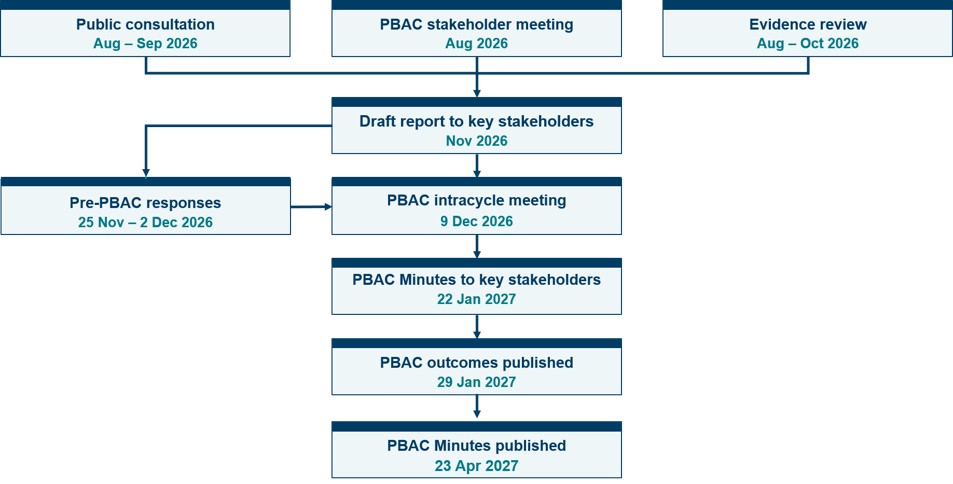
The PBAC asked that a report be ready for consideration at its intracycle meeting in December 2026. The review process and timelines are provided below. Diagram 1 provides a visual representation. Please note that timeframes are indicative only.
PBAC stakeholder meeting: August 2026
The PBAC Chairs will hold a stakeholder meeting with peak clinical and consumer groups, and relevant pharmaceutical sponsor companies. We will publish an outcome statement from this meeting around eight weeks later.
Public consultation: August – September 2026
Public consultation opened on 20 August 2026, via the Consultation Hub. Consumers, organisations, health professionals, pharmaceutical sponsors and interested members of the public are invited to provide comments addressing the review’s research questions. Consultation will close on 1 October 2026.
We will prepare a summary of the submissions received for the PBAC and the draft report. We will publish the summary on the website by 23 April 2027.
Evidence review: August – November 2026
We will contract a Health Technology Assessment (HTA) evaluation group to prepare a report on research questions 1-4.
The PBAC considered an analysis of the use of RRMS medicines in July 2025. We will update this analysis to address research question 5.
Draft report to key stakeholders & Pre-PBAC response: 25 November – 2 December 2026
We will provide selected clinical and consumer groups and pharmaceutical sponsors with a draft report by 25 November 2026. We will invite them to provide a pre-PBAC response by 2 December 2026. If possible, the draft report will be provided earlier.
PBAC consideration: 9 December 2026
The PBAC will consider the draft report at its December 2026 intracycle meeting.
PBAC Minutes to key stakeholders: 22 January 2027
We will provide the PBAC Minutes in-confidence to selected clinical and consumer groups and relevant pharmaceutical sponsors.
PBAC outcomes published: 29 January 2027
We will publish the outcomes for the December 2026 intracycle meeting.
PBAC Minutes published: 23 April 2027
We will publish the PBAC Minutes for this item.
Diagram 1: Process and indicative timeline for the RRMS medicines research project
Additional background
PBAC consideration of ofatumumab - March 2024
In March 2024, the PBAC considered a request by the sponsor of ofatumumab to separate the current RRMS higher-efficacy tier into two distinct efficacy tiers (moderate- and high-efficacy). The PBAC did not recommend separating the current higher-efficacy disease-modifying therapies (DMT) tier into two distinct efficacy tiers on the basis that the clinical evidence presented did not adequately support the submission’s claim that ofatumumab (proposed as a high-efficacy tier DMT) has superior comparative effectiveness versus fingolimod (as a proxy for the proposed mid-efficacy tier DMTs). For further information please refer to the Ofatumumab March 2024 Public Summary Document.
PBAC consideration of ublituximab - May 2025
At its May 2025 meeting, the PBAC recommended PBS-listing of ublituximab for the treatment of RRMS if it were cost-minimised to the least costly alternative therapy available on the PBS for RRMS previously classified into the higher-efficacy tier. The PBAC considered it would be useful to better understand how RRMS therapies are being used on the PBS, with a potential for further review to ensure the listings and therapeutic relativities remain consistent with the contemporary evidence base. For further information please refer to the Ublituximab May 2025 Public Summary Document.
Drug Utilisation Sub-Committee (DUSC) Utilisation Review of RRMS medicines – June/July 2025
At its meeting in July 2025, the PBAC considered a utilisation analysis and advice from the June 2025 DUSC meeting on the current market for PBS-listed medicines for RRMS. For further information refer to the Utilisation analysis of RRMS medicines.
Further information
Read more on post-market reviews on the Reviews website.
Please direct any enquiries to the Quality Use of Medicines Reviews and Programs Section.
Subscribe to PBS News for the latest updates regarding reviews, including public consultation, and publication of review reports.